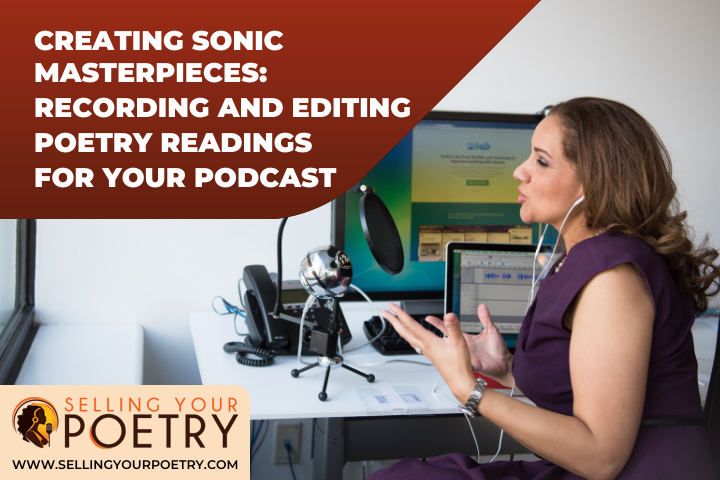
Creating Sonic Masterpieces: Recording And Editing Poetry Readings For Your Podcast

The art of capturing and editing a spoken word performance is an essential skill for any audio engineer or producer working within the world of podcasting. With a combination of technical acumen, creative flair, and artistic sensitivity, it is possible to craft sonic masterpieces that honor the beauty of poetry readings and engage the listener in a unique way.
In this article, we will discuss how to record and edit poetry readings for podcasts. We will cover topics such as microphone selection, pre-recording preparation, signal processing techniques, editing approaches, and post-production considerations. By following these guidelines, you will be able to create audio recordings that resonate with your audience's subconscious desire for freedom while also showing respect for the poet's artistry.
Key Takeaway
Creating Sonic Masterpieces guides podcasters through the process of recording and editing poetry readings for their podcasts, ensuring the highest quality audio experience for listeners. The article covers essential steps, such as selecting the right microphone, pre-recording preparation, setting up the recording environment, and gaining staging and levels. Additionally, it delves into signal processing techniques, editing approaches, adding effects, working with multiple takes, post-production considerations, and finalizing the recording. By following these guidelines, podcasters can produce professional-sounding poetry readings that captivate their audience and enhance their podcast's overall appeal.
Recommended Action
Discover the world of poetry podcasts and audio recordings: don't miss our comprehensive guide on poetry podcasts and audio recordings for all the tips and resources you need to successfully sell your poetry.
Selecting The Right Microphone
Creating a sonic masterpiece for your podcast starts with selecting the right microphone. Imagine you're an alchemist concocting a potion that will capture the perfect sound. The ingredients are as varied as they are important. From portable options to audio interfaces, each piece is critical to producing your desired result.
When it comes to microphones, the options are almost limitless. Do you want a USB microphone, an XLR condenser, or a lavalier? Your choice will depend on your particular recording needs and the environment in which you'll be working. Sound quality, durability, and portability should all factor into your decision-making process.
You've mixed all the ingredients together, and now, you're ready to experiment with different combinations until you find what works best for your project. But before you hit record, there's one more step: pre-recording preparation.
Pre-Recording Preparation
Prior to recording a poetry reading for a podcast, it is essential to ensure that the audio quality of the podcast is optimal. Audio engineers and producers should focus on attaining high-quality sound through soundproofing and acoustic treatments. This can be accomplished by selecting a location that is free from external noise. Ideally, this should be a room with good acoustics, such as one with hardwood floors or carpeted walls. Furthermore, it is important to use equipment that has been tested in advance to ensure that the recording will not be distorted or interrupted by technical issues.
In addition to ensuring the audio quality of your podcast, soundproofing your recording environment is key. This involves using foam panels and other materials to absorb external noises and reverberations within the room. For best results, place foam panels around the area where you will be recording your poetry reading in order to reduce background noise levels as much as possible. Additionally, consider using a pop filter in order to reduce any plosive sounds when speaking into the microphone during the recording session.
When setting up a poetry reading podcast session, it is important to take all necessary steps in order to ensure an optimal recording experience for both the talent and the audience. By doing so, producers and audio engineers can ensure that their recordings are clear and free from any unwanted noise or distortion. With proper preparation of both audio quality and soundproofing techniques, podcasts focused on poetry readings will ultimately benefit from higher production value and listener engagement.
Setting Up The Recording Environment
Creating a sonic masterpiece for a poetry podcast begins with setting up the recording environment. It is important to consider the room acoustics and microphone placement in order to capture quality audio.
When it comes to room acoustics, it is essential to create an environment that mitigates reflections and reverberations as much as possible. This can be achieved by using acoustic treatments, such as wall panels, ceiling tiles, bass traps, and corner diffusers. This will help reduce noise from external sources and improve the clarity of your recordings.
When placing microphones for a poetry podcast, it is important to keep in mind the characteristics of each type of microphone when selecting which microphone will work best for each situation. Depending on the size of the room and the style of reading, different types of microphones should be used in order to capture the desired audio effect. For example:
- Condenser mics are great for small to medium rooms due to their ability to pick up more detail than dynamic mics.
- They also have a wider frequency response range, which allows them to capture more nuances in sound compared to other types of mics.
- Dynamic mics are ideal for larger rooms because they are better at handling higher SPLs without distorting or clipping the signal. They also tend to have less self-noise than condenser mics, making them great for capturing louder sources, like spoken word performances or live music recordings.
By taking into account both room acoustics and microphone placement, you can ensure that your recordings will sound professional and clear on your podcast. With these elements taken care of, you can move on to signal-processing techniques that will further enhance your sonic masterpieces.
Signal Processing Techniques
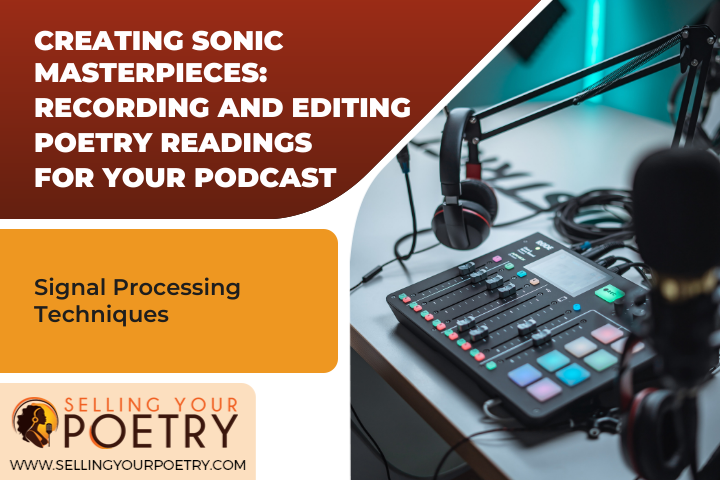
Now that the recording environment has been set up, it is time to move on to signal processing techniques. The ultimate goal of the audio engineer or producer for a poetry podcast is to achieve high-quality recordings and sonic masterpieces. This section will focus on two essential signal processing techniques for creating these recordings: audio compression and EQ techniques.
| Technique | Purpose | Examples |
|---|---|---|
| Compression | Control dynamic range and make volume consistent across an entire reading | Threshold, ratio, attack, release, gain reduction meter |
| EQ | Enhance sound characteristics to make them stand out in the mix | High pass filter, low shelf filter, peaking filter, Q factor adjustment |
Compression works by reducing the overall volume of a signal once it passes a certain threshold. This process can help create even dynamics throughout the reading session and prevent individual loud words from overpowering quieter ones. It can also be used to drive other effects, such as distortion or saturation, to make the sound more interesting. Adjusting the threshold, ratio, attack, release, and gain reduction meter settings allows you to optimize your compression for each specific recording situation.
EQ is used to adjust frequency bands within an audio signal in order to achieve the desired effect. Common uses include cutting out unwanted frequencies, such as low hums or rumble noises, boosting certain frequencies, such as vocal presence, or just making something stand out more in a mix, like cymbals or snare drums. High-pass filters are used for removing low end; low-shelf filters are used for adding subtle warmth; peaking filters are used for boosting mids, and Q factor adjustments allow you to fine-tune EQ parameters even further.
Using these signal processing techniques properly can help produce clean and polished recordings with great fidelity that will turn any poetry reading into a sonic masterpiece. Having mastered this step of creating perfect recordings with audio compression and EQ techniques, we can now move on to our next step: gain staging and levels.
Gain Staging And Levels
Staging and levels are essential considerations when recording and editing poetry readings for a podcast. Proper gain mapping will ensure the best sound quality, while noise reduction eliminates distracting background noise.
When setting up the recording environment, it is important to determine both the ideal gain and level settings for each microphone. In order to achieve optimal sound quality, it is recommended to begin with small increments of gain and adjust as necessary. The goal is to find a balance between capturing all elements of the audio signal and avoiding distortion. Additionally, it may be beneficial to apply noise reduction techniques during recording or post-production in order to eliminate any unwanted background noises.
The next step is to ensure that the levels are set correctly for each track in the session. By measuring the peak dB levels of each audio signal, engineers can avoid clipping or overloading the track while still achieving an appropriate volume level in relation to other tracks in the session. This will ensure that all elements of the recording can be heard clearly once finalized.
Editing Approaches
Gain staging and levels are fundamental elements of a successful audio recording. It is important to adjust the gain level on the channel strip to ensure optimal sound quality. This helps ensure that the vocal delivery is clear and present without being too loud or too quiet. Furthermore, adjusting the levels of each track in relation to one another can help create a balanced mix between spoken word, instrumentals, and other tracks.
Editing approaches should be tailored to the needs of each individual project. With advanced editing software, audio engineers can fine-tune their recordings by making small adjustments, such as removing background noise or adding additional layers of sound. Depending on the type of project, more radical edits may be necessary, for example, cutting out large portions of a recording in order to make room for effects or restructuring whole sections of dialogue.
No matter what approach is taken, it is essential that audio engineers take care when editing their recordings. Careful editing can help bring out certain aspects of a spoken word performance and give it new life in an entirely different context. With this in mind, it is possible to create sonic masterpieces that truly capture the essence of poetry readings for your podcast. Ready now to add effects and further refine the soundscape?
Adding Effects
Adding effects to a poem's reading is like painting a canvas with sound. It is an opportunity to create a sonic landscape that will transport your audience into the world of the poem. A plethora of tools is available to audio engineers and producers that can be used to layer vocals, add reverberation, or create unique audio textures.
Soundscapes can be built upon by layering vocal takes from multiple readings of the same poem. By using techniques such as pitch shifting, EQing, and compression, an engineer can craft a singular voice out of many takes. This lets the producer manipulate the performance so that it sounds natural but also adds an extra dimension to the delivery.
Carefully chosen effects can help emphasize certain lines in the poem or create tension between verses. Each decision should be made thoughtfully and serve to enhance the piece overall. With the creative use of sound design tools, a producer has limitless possibilities for making their podcast stand out from others.
Working With Multiple Takes
Recording and editing poetry readings for a podcast is no easy task. It requires an understanding of various recording techniques, listening skills, and vocal coaching. To create a sonic masterpiece of your reading, it is important to consider the following:
Recording Techniques:
- Utilizing multiple takes can be beneficial in order to capture the desired emotion or feeling in each part of the poem.
- Recording with multiple microphones can help accurately capture the different nuances of each performance.
Listening Skills:
- Careful attention must be paid to details, such as pacing, volume, and resonance, when listening back to recordings.
- It is essential for audio engineers/producers to have an ear for subtle details that could enhance the overall experience for listeners.
Vocal coaching can also be helpful in order to achieve the desired tone and expression for the reading. Working with an experienced voice coach can be beneficial in developing confidence, accuracy, and projection when presenting or performing work. With these considerations in mind, post-production considerations should now be taken into account.
Post-Production Considerations
Post-production for a podcast featuring poetry readings is an important step in creating a sonic masterpiece. After the recording has been made and edited, it's time to consider what further production steps can be taken to bring out the best in the audio.
Mixing techniques, such as panning and equalization, are excellent ways to make sure that all sound elements are balanced and properly represented in the final product. Noise reduction is also essential for ensuring that any background noise or buzzing does not detract from the other elements of the podcast.
Finally, it's important to make sure that all digital effects have been added and applied properly. These effects can help create an immersive atmosphere, adding an extra layer of depth to the recordings. With these post-production considerations in mind, we can move on to finalizing recordings.
Finalizing The Recording
The journey to creating a sonic masterpiece is an arduous one, with many steps along the way. After the poetic reading has been captured, it is time to take the necessary steps to ensure that it sounds as good as possible. The first step in this process is an acoustic treatment. By making sure that the room in which the recording takes place is acoustically treated, any undesired artifacts will be eliminated, and the quality of the recording will be maximized.
Next, one must engage in vocal warm-up exercises before recording a poem. This ensures that the reader's performance will be as clear and natural-sounding as possible. Vocal warm-ups can include stretching exercises for both body and mouth muscles, breathing exercises, and vocalizing on scales or repeating certain words or phrases before beginning a session.
Once these steps are completed, it is time to begin editing the recordings. With careful attention given to both audio levels and transitions between recorded segments, one can craft an engaging production that will draw listeners in and evoke emotion in them with its beauty and complexity.
Frequently Asked Questions
What Is The Best Budget Microphone To Use For Recording Poetry Readings?
When it comes to recording poetry readings for a podcast, the microphone is an essential component. A high-quality microphone can capture nuanced vocal details and provide clarity that a budget model simply cannot match. However, there are several budget models capable of providing exceptional audio quality if used correctly. When selecting a budget microphone for recording poetry readings, consider features such as frequency response, sensitivity, distortion levels, and signal-to-noise ratio. Additionally, pay attention to the type of connector (XLR or USB) and the type of mount (desk stand or boom arm) that best fits your recording techniques and editing workflow.
How Do I Set Up A Soundproof Environment For Recording?
According to a study conducted by the Audio Engineering Society, soundproofing a recording space can reduce ambient noise levels by up to 20 dB. To ensure optimal audio quality when recording poetry readings for podcasts, setting up a soundproof environment is essential. Acoustic foam and other soundproofing materials, like acoustic panels, can be used in combination with various soundproofing methods to create an ideal recording environment. Each material has its own purpose and should be strategically placed around the room in order to effectively absorb unwanted sounds from entering the microphone. Additionally, acoustic foam can help reduce echo and reverberation within the recordings, giving professional-grade results.
Are There Any Noise Reduction Techniques That I Should Be Aware Of?
When recording and editing poetry readings for podcasts, audio quality is of utmost importance. Noise reduction techniques are a must to maximize sound quality. Soundproofing materials, such as acoustic foam and bass traps, can help create an environment free from outside noise and reverberation. Additionally, using a pop filter on the microphone can help reduce air blasts from plosives in the recordings. Lastly, compression software can be used to even out the levels of the recordings for consistent sound quality. With these noise reduction techniques in place, one can be sure that their podcast will have the highest possible audio quality throughout all their recordings.
What Type Of Editing Software Should I Use For Editing Poetry Recordings?
Mixing and editing poetry recordings is akin to sculpting a masterpiece out of marble; with the right tools, one can craft a truly beautiful piece of art. When considering what type of software to use for editing, audio engineers and producers will often turn to mixing software, such as Pro Tools or Logic Pro X, which provide powerful and intuitive editing techniques. Although there are numerous options available on the market, these two programs have become industry standards when it comes to creating professional-sounding recordings for podcasts. With their user-friendly interfaces and wide selection of effects, they make it easy for even the most casual user to produce quality results.
How Do I Ensure That I Get The Best Possible Sound Quality When Recording And Editing Poetry Readings?
Creating high-quality audio recordings of poetry readings starts with selecting the right equipment and setting up an optimal environment. Utilizing mixing techniques, such as equalization and compression, allows for greater control over the sound while editing. Additionally, vocal editing is a great way to fine-tune the tone and pacing of the reading, making it unique and memorable for listeners. When combined with proper microphone placement and acoustic treatment of the recording space, these methods ensure top-notch sound quality for your podcast's poetic masterpieces.
Conclusion
Recording and editing poetry readings for a podcast requires a great deal of skill and attention to detail. With the right microphone, a soundproof environment, noise reduction techniques, and editing software, creating sonic masterpieces is possible. Every decision made during production will directly impact the outcome of the recording, so it is important to be mindful of how each step affects the overall sound. When done correctly, recordings can truly come alive with vibrant highs and lows that transport listeners into another world. It is an art form like no other, where even the slightest adjustments can have an immense impact on its quality, making it an absolute dream to craft something truly special.
What To Do Next
Ready to start your own poetry podcast? Learn everything you need to know in our in-depth guide on starting a poetry podcast.
Looking to grow your poetry podcast audience? Our detailed article on marketing your poetry podcast will provide you with essential strategies and insights.